If you’ve ever glanced at your wrist and felt reassured by the steady sweep (or tick) of a watch hand, you’ve participated in a very old human habit: turning the abstract flow of time into something we can see, count, and coordinate. Long before mechanical watches, people used the sky, shadows, and flowing water to give structure to days and nights - then gradually engineered that structure into portable precision. For a watch brand like MN Watches, this story is more than history; it’s the lineage behind every dial, hand, and movement.

Image source: MN-Watches.com
Reading time in nature: sky, stars, and shadows
The earliest “timekeeping” wasn’t a device at all. It was observation - sunrise and sunset, the waxing and waning of the Moon, seasonal changes, and the predictable motion of stars. Ancient societies learned that repeating patterns in the heavens could anchor agriculture, religious rituals, navigation, and civic life.
In ancient Egypt, for example, night hours could be tracked using star groups (often described in modern sources as “decans”), while daytime could be estimated by the Sun’s position. This wasn’t “minutes and seconds” as we think of them today - hours could vary in length by season - but it was a powerful breakthrough: time as a system, not just a feeling.
Soon, observation became instrumentation. Sundials and “shadow clocks” transformed sunlight into readable intervals, using a gnomon (a shadow-caster) to mark the passing hours. Archaeological and museum evidence shows Egypt used these solar methods by roughly the second millennium BCE, making them among the oldest known practical time devices.

Image source: researchgate.net (Egyptian Shadow Clock)
Measuring time when the sun disappears: water clocks and the night shift
Sundials are elegant - but they fail at night and in cloudy weather. The solution was ingenious: measure time through flow.
Water clocks (clepsydrae) track time by regulating water moving into or out of a vessel, then reading the level against markings. Evidence and historical discussion place early water clocks in parts of the ancient world well over three thousand years ago, including Egypt and Mesopotamia/Babylonia.
Water clocks mattered because they created timekeeping independence from the Sun. Priests could schedule nighttime rites; officials could standardize watches and duties; astronomers could log observations with more consistency. They also nudged societies toward the idea that time should be measured uniformly - even if early methods still had variability and calibration challenges.

Image source: coronet.org (Outflow Water Clock)
From flow to gears: the medieval leap into mechanical time
The next revolution wasn’t about reading nature - it was about building an artificial heartbeat.
Mechanical clocks, developing in medieval Europe, used gear trains and escapements to convert stored energy (weights or springs) into controlled motion. These early clocks were often large public installations - tower clocks that regulated civic life - because they were complex and required maintenance. Over time, refinements in escapements and manufacturing improved reliability, making mechanical timekeeping increasingly practical beyond cathedrals and city squares.
This shift changed society: time became something public, shared, and enforceable. Bells marked hours; work and trade gained stronger rhythms; communities synchronized around a common standard rather than individual observation.

Image source: reddit.com (Prague Astronomical Clock)
Precision arrives: pendulums, springs, and the quest for accuracy
Once gears could “count” time, the main problem became accuracy. The greatest enemy was irregular motion: early regulators drifted and varied.
A major improvement came with better oscillators - mechanisms that swing or vibrate at stable rates. Pendulum regulation dramatically boosted accuracy in stationary clocks, while spring-driven systems and improved escapements helped make time portable. The portable question - how to keep accurate time on a moving ship - became one of history’s most consequential engineering challenges, because longitude at sea depends on reliable timekeeping.
This era also shaped the cultural meaning of timepieces. Clocks and watches became status objects, scientific tools, and personal companions - moving from public towers into homes, pockets, and eventually onto wrists.

Image source: theoldclockworks.com (Pendulum Clock Regulator)
The wristwatch era: time becomes personal, wearable, and everywhere
Wristwatches didn’t just miniaturize timekeeping - they normalized constant access to it. The watch dial became a human interface for time: legible markers, contrasting hands, luminous material, and thoughtful layout turned a measurement system into something instantly readable.
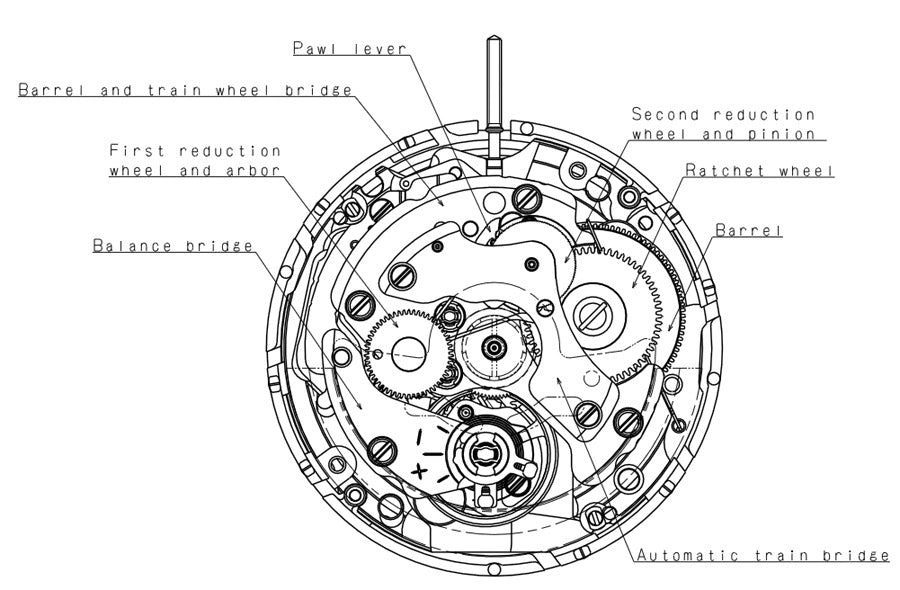
Mechanical wristwatches refined the art of translating oscillation into display. Even in a world of smartphones, a mechanical watch remains a uniquely human technology: a tiny engineered ecosystem of springs, gears, and a regulating organ, turning stored energy into orderly motion - visible on the dial and tangible on the wrist.

Image source: mn-watches.com (skeleton watch movement)
Quartz changes everything: the 20th-century accuracy revolution
In the 20th century, timekeeping jumped to a new foundation: electronics. Quartz crystals vibrate at highly stable frequencies when energized, making them superb oscillators. A landmark moment came in 1927, when Bell Labs researchers Warren Marrison and Joseph Horton built an early quartz clock, demonstrating the remarkable precision of quartz-controlled oscillation.
Quartz technology ultimately transformed consumer timekeeping by delivering high accuracy at scale - driving what became known as the “quartz revolution.” For many people, quartz defined what “accurate” meant, resetting expectations for everyday clocks and watches.

Image source: wikipeaia.com (Seiko Astron Quartz Movement)
Atomic time: redefining the second and synchronizing the planet
Quartz is impressive, but atomic clocks are in a different universe. Instead of counting a swinging pendulum or a vibrating crystal, atomic clocks count the frequency of electromagnetic transitions in atoms - an extraordinarily stable “tick.” Atomic timekeeping underpins modern infrastructure: global telecommunications, navigation, and precision timing networks depend on it.
This is where time stops being merely personal and becomes planetary. Systems like GPS rely on extremely precise timing; even tiny errors can translate into major positional inaccuracies. Atomic clocks, and the standards organizations that maintain time scales, quietly keep modern life synchronized.

Image source: ingenia.org.uk (Atomic Clock)
So where does a mechanical watch fit in a digital world?
If atomic clocks can measure time with stunning accuracy, why do mechanical watches still matter?
Because “telling time” has never been only about accuracy. It’s also about meaning, craft, and the satisfaction of a visible mechanism doing something fundamental. Mechanical watches are a living museum you can wear: they embody centuries of invention - from shadows to flowing water to gears to oscillators - translated into a human-scale object.
That heritage is part of what makes a well-designed dial compelling: the clarity of markers, the balance of proportions, the quiet discipline of a movement doing its job. In a very real way, every mechanical watch carries the entire story of timekeeping - compressed into millimeters.

Image source: mn-watches.com
Ready to start building your collection? Browse our mechanical watches now!
Learn more about MN Watches and our design philosophy here.
To see our most recent watch builds, click here.