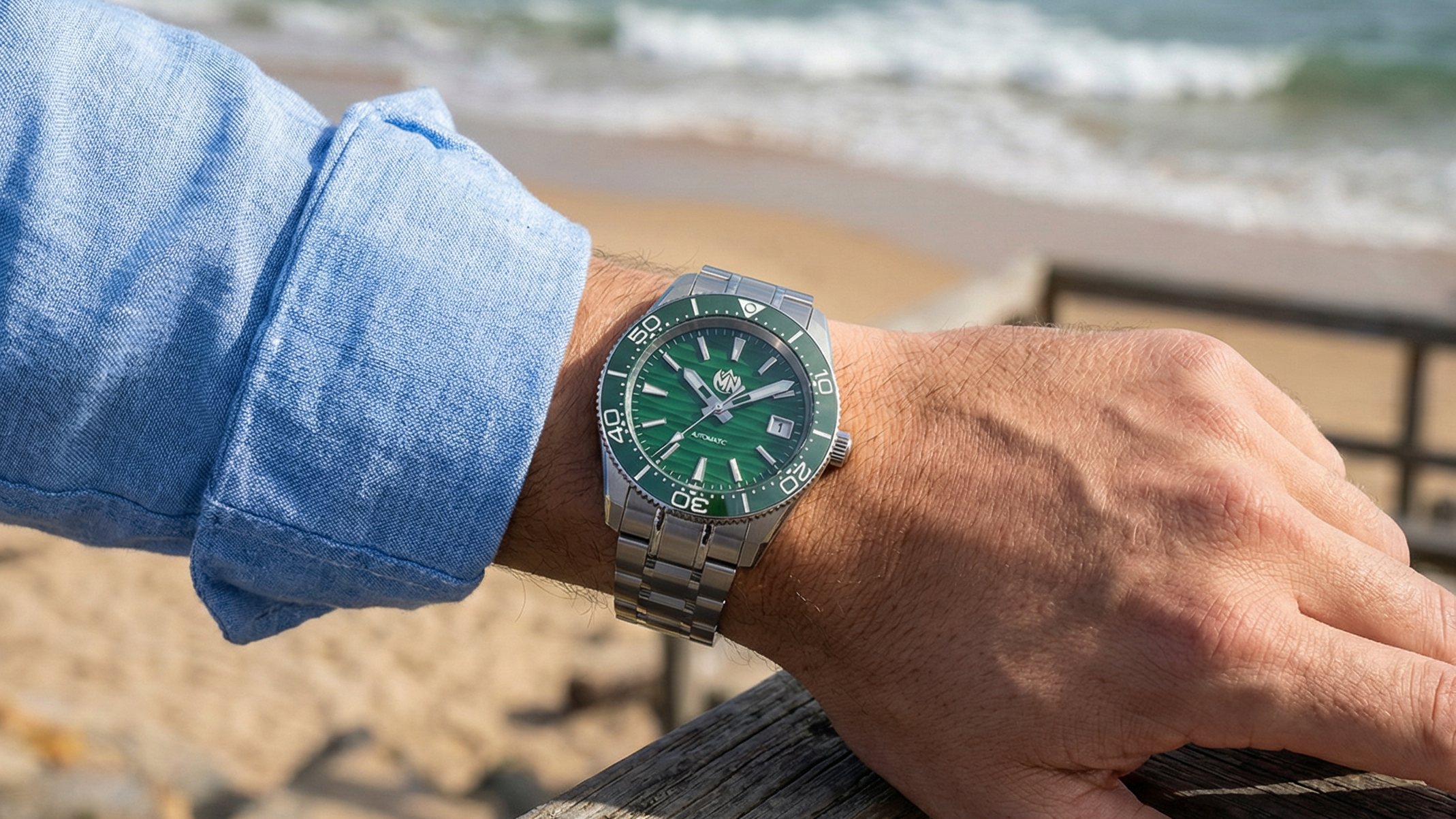
Mechanical watches are tiny, wearable machines that measure time by counting oscillations. Unlike quartz, which is locked to an electronic resonance, a mechanical movement’s “clock” is a balance wheel and hairspring assembly whose period is influenced by friction, gravity, temperature, magnetism, shock, and even how far the mainspring is wound. Regulation is the craft (and increasingly the science) of steering that oscillator so the watch runs consistently - across positions, over the power reserve, and through real-world conditions.

Image source: mn-watches.com (balance wheel, hairspring & regulator assembly)
What “accuracy” means in a mechanical watch
In day-to-day use, accuracy usually means rate: how many seconds per day (s/d) the watch gains or loses compared to a reference time source. But watchmakers also care about stability: whether the rate stays similar as the watch changes position (dial up vs crown down), as lubrication ages, and as the mainspring unwinds.
This is why chronometer certifications define accuracy as a set of measurements under defined conditions, not a single number. For example, COSC tests uncased movements over 15 days in multiple positions and temperatures, and its well-known target for the average daily rate is –4 to +6 s/d. METAS “Master Chronometer” testing is performed on the cased watch and includes additional hurdles (notably anti-magnetism), with a commonly cited daily rate window of 0 to +5 s/d.

Image source: mn-watches.com (Gian/Loss per day vs Positional Variation)
Beat error: what it is, and why it matters
A timing machine “listens” to the escapement and calculates three headline values:
Rate (s/d): the immediate measured gain/loss.
Amplitude (degrees): how far the balance swings.
Beat error (ms): how unevenly the “tick” and “tock” are spaced in time.
Beat error is the time difference between the tick and the tock relative to the ideal symmetry of the balance’s motion. In a perfectly “in beat” watch, the pallets unlock at equal intervals on each half swing. When the impulse point is off-center - because of how the hairspring is connected to the balance staff, how the spring is pinned, or how the escapement is set - the timing machine reports a beat error in milliseconds.
Why care? A watch can show a decent rate while still having a meaningful beat error, but beat error often correlates with poorer efficiency and less stable performance across positions. It can also be a clue that the oscillator geometry is not centered, which may reduce amplitude or make regulation more sensitive to shocks.

Image source: mn-watches.com (Timegrapher machine)
Different movement architectures regulate differently
Not all mechanical movements are built - or intended - to be tuned the same way. Regulation strategy depends on architecture and on what the maker prioritized: serviceability, shock robustness, mass production, or ultimate precision.
Manual-wind vs automatic
Manual-wind movements often have slightly fewer energy losses because they lack an automatic winding module, but that doesn’t automatically make them more accurate. Automatics can be very consistent in real wear because the mainspring is kept nearer a stable state of wind - reducing the size of rate change over the power reserve (isochronism). In contrast, a manually wound watch worn lightly and wound inconsistently can live in the “less optimal” part of its torque curve, showing bigger rate swings.
Integrated movements vs modular add-ons
A modular chronograph (a base movement with a chronograph module added on top) can regulate very well, but the added friction and vertical stack can change amplitude and rate when the chronograph is running. Integrated chronographs typically manage power flow more predictably. Regulation must account for the watch’s intended operating modes: chronograph on/off, date change load, or high-complication energy demands.
High-beat vs low-beat
Beat rate (e.g., 18,000 vs 28,800 vibrations per hour) changes what regulation “feels” like. Higher beat rates can average out small disturbances and improve short-term stability, but they increase sliding friction and may be less forgiving of marginal lubrication. Lower beat rates can deliver strong amplitude and potentially longer service intervals, but may show more sensitivity to small shocks or positional disturbances. There’s no universal winner - only trade-offs that the regulator compensates for.
Swiss lever, co-axial, and other escapements
Most modern mechanical watches use the Swiss lever escapement, which has sliding friction at impulse surfaces and is sensitive to lubrication condition. Other escapements (like co-axial variants) aim to reduce sliding friction at impulse, potentially supporting longer-term stability, but they also introduce different geometric constraints and service requirements. Regardless of escapement type, regulation still revolves around the oscillator: balance, hairspring, and their interaction with the escapement.
Index-regulated vs free-sprung: two philosophies of tuning
The most visible difference in regulation hardware is how the effective length of the hairspring is controlled.
Index regulation (moving the regulator)
Many movements use an index regulator with curb pins that effectively shorten or lengthen the active portion of the hairspring. Moving the regulator changes rate quickly and is efficient for production and service. The downside is that curb pin interaction and hairspring centering can introduce subtle non-linearities, especially if the spring “breathes” asymmetrically. Excellent results are still achievable, but the system rewards careful geometry.
Free-sprung, variable-inertia balances (moving the balance, not the spring)
In a free-sprung design, the hairspring length is fixed; rate is adjusted by changing the balance’s moment of inertia (often via screws or weights on the rim). In principle, this can improve long-term stability and shock resistance of the setting because the hairspring’s active length stays constant. It can also make fine adjustment more time-consuming and demands more precision in poising and hairspring shaping.
Both systems can be chronometer-grade; the movement’s overall design quality, escapement efficiency, hairspring metallurgy, and finishing tolerances matter at least as much as the headline regulation method.
The timing machine is only as good as its setup
Timing machines infer rate and amplitude from acoustic signals. To compute amplitude properly, the machine needs the lift angle of the escapement - an angle that varies by movement family. If the lift angle is set incorrectly, the amplitude value can be misleading even if the rate reading is roughly useful. Interpreting results responsibly means knowing the movement’s lift angle (or accepting amplitude as a relative, not absolute, indicator).
 Image source: mn-watches.com (Lift Angle & Amplitute)
How watchmakers actually regulate a mechanical watch
Regulation is usually an iterative loop: measure → adjust → re-measure, across conditions that mimic reality. In a workshop context, a competent approach often looks like this:
First, the watch is checked for health before it is tuned for numbers. Magnetism, dried lubrication, damaged pivots, a bent hairspring, or excessive endshake can create symptoms that regulation cannot truly cure. If the movement is not mechanically sound, a “perfect” timegrapher result might vanish the moment the watch leaves the bench.
Next comes establishing a baseline. The watch is typically measured in multiple positions (dial up/down, crown up/down/left/right depending on practice) and at different states of wind. A modern target isn’t simply “zero seconds per day” in one position; it is controlled dispersion: small differences between positions and a stable rate over time.
If beat error is high, many watchmakers address it early. Beat correction is not primarily a “regulator lever” problem; it’s about centering the oscillator’s action relative to the escapement. Depending on the movement, this may involve adjusting the hairspring collet relationship to the balance staff, or using a dedicated beat adjustment feature if present. Beat error is measured again after each correction.
Then amplitude is considered. Low amplitude can come from low mainspring torque, excessive friction, escapement issues, or poor lubrication. Since amplitude affects how the escapement unlocks and impulses the balance, chasing rate without addressing weak amplitude can lead to a watch that “regulates” on the bench but drifts on the wrist.
Only after beat and amplitude are within a healthy range does the fine rate adjustment become meaningful. With an index-regulated movement, this can be a small regulator move followed by micro-adjustments. With a free-sprung balance, it often means careful, incremental changes to inertia weights or screws. The watchmaker then checks positional spread again. A classic goal is not merely to hit a rate number but to reduce the difference between horizontal and vertical positions and tighten the movement’s day-to-day repeatability - exactly the kind of behavior chronometer standards attempt to capture.
Finally, real-world factors are considered. A watch that passes a lab-style test might still disappoint if the wearer’s habits are unusual: desk work that keeps the watch mostly crown-down, frequent shock exposure, or leaving the watch near magnetic clasps. Some brands therefore certify not only the movement but the cased watch under additional stresses, as METAS does, including anti-magnetism and daily rate requirements.
Why “regulated” doesn’t mean “perfect forever”
Even a beautifully regulated watch is still mechanical. Lubricants age, oils migrate, and the friction profile of the escapement changes. Shock events can disturb hairspring geometry. Temperature swings affect balance spring elasticity (modern alloys reduce this, but don’t erase physics). And service intervals matter: regulation is a finishing step, not a substitute for maintenance.
If you want to communicate accuracy credibly on a brand site, it helps to be explicit about context: whether the stated performance is in a single position, across positions, at full wind, or as a wearable expectation. This is why formal standards are useful as a shared language - COSC’s testing regime and thresholds are widely understood, and METAS adds a modern, cased-watch perspective.
Practical takeaways for enthusiasts (and for MN Watches customers)
The most honest story about mechanical accuracy is that it’s engineered consistency, not absolute perfection. A well-designed movement with healthy amplitude, low beat error, and tight positional variation will feel “accurate” in daily life - even if it isn’t exactly zeroed to atomic time. Regulation is the bridge between a movement’s theoretical capability and its real performance on a human wrist.
For MN Watches, this topic is also a chance to educate customers on what you’re actually delivering: not just a number, but a tuned system - balance, spring, escapement, and careful adjustment - validated by measurement and grounded in how mechanical timekeeping truly works. If you'd like to learn more about our build process, check out our build blog here.
Ready to start building your collection? Browse our mechanical watches now!
Learn more about MN Watches and our design philosophy here.
To see our most recent watch builds, click here.
Selected references:
Contrôle Officiel Suisse des Chronomètres (COSC). COSC FAQ – Criteria and Testing Process.
https://www.cosc.swiss/cosc-faq
Time+Tide Watches. What is COSC Certification?
https://timeandtidewatches.com/what-is-cosc-certification/
Federal Institute of Metrology (METAS). METAS N001 – Certification of Mechanical Watches (Master Chronometer Standard).
https://www.metas.ch/dam/metas/en/data/dokumentation/rechtliches/zertifizierung-uhren/metas_n001_v_1_2-e.pdf.download.pdf/metas_n001_v_1_2-e.pdf
Tudor Watch. METAS Certification Explained.
https://www.tudorwatch.com/en/inside-tudor/watchmaking/metas-certification
Horlogerie Suisse / Watchmaking Glossary (H2i). Glossary of Watchmaking Terms – Beat Error Definition.
https://h2i.ch/glossary-of-watchmaking-terms/