
Not exactly.
Behind that elegance lies one of the most technically demanding mechanisms in modern horology. The big date is a perfect example of a complication that looks minimal but hides an intricate ballet of gears, discs, springs, and tolerances beneath the surface.
Let’s explore why the big date is such a celebrated - and challenging - feat of mechanical engineering.
Two Numbers, One Perfect Moment: The Synchronization Problem
Unlike a standard date wheel that rotates a single disc, most big date systems rely on two independent date discs: one for the tens and one for the units.
This creates a major engineering puzzle:
-
The discs must jump at the same instant.
-
They must land perfectly aligned within a large window.
-
Neither disc can lag, stall, or overshoot.
The bigger the aperture, the easier it is to spot even the tiniest misalignment—often just 20–30 microns.
For a complication meant to look clean, the underlying mechanics must be anything but simple.

Instantaneous Jump = High Torque + High Stress
Many big date displays perform an instant jump at midnight rather than a slow creep.
Achieving that requires:
-
Accumulating energy throughout the day in a cam or spring
-
Releasing that energy in a sharp, controlled burst
-
Moving one or two discs simultaneously
This sudden torque load puts real stress on the gear train. If the system isn’t perfectly balanced, the watch’s timekeeping can suffer.
It’s a bit like asking a ballet dancer to lift two partners at once—graceful when done right, disastrous when misjudged.

Avoiding "Ghost Numbers" and Half-Jumps
Transitions like 09 → 10 or 31 → 01 are deceptively tricky. The movement must:
-
Trigger two discs at once
-
Prevent them from showing intermediate digits
-
Avoid partial jumps visible through the large window
To solve this, watchmakers employ clever sequencing mechanisms: star wheels, Maltese crosses, coded cams, jumper springs. One miscalculation, and your elegant big date turns into a horror show of off-center numerals.
Ready to start building your collection? Browse our mechanical watches now!

Microscopic Tolerances on a Macroscopic Display
Here’s the irony:
Big date windows make small mistakes very visible.
Every component—the discs, the print, the pivots, the apertures—must be made to extremely tight tolerances. Even the thickness of the discs matters; if one sits slightly higher, their shadows behave differently under light and the illusion of a single, unified display is broken.
If the big date looks perfect, it’s because it’s engineered with obsessive precision.
More Fragile Than It Looks
A big date mechanism contains:
-
More wheels
-
More levers
-
More springs
-
More sources of friction
And therefore… more to go wrong.
Users can easily damage a poorly designed system by quick-correcting the date near midnight, which is why many big date movements incorporate blocking systems or slip clutches. But those safety features add even more complexity.
In short: the big date is a high-maintenance diva. Treat it well.

Aesthetic Constraints Make Engineering Harder
The big date window usually needs to sit:
-
Central or slightly above center
-
Perfectly horizontal
-
Balanced with the brand logo or other dial elements
But the movement underneath may not naturally support that location.
This often forces watchmakers to re-engineer wheel trains, bridges, or the entire calibre layout—all to make sure the complication sits exactly where the dial designer wants it.
It’s haute horlogerie's equivalent of redesigning your house so the windows align with the horizon.
Brands That Master the Big Date

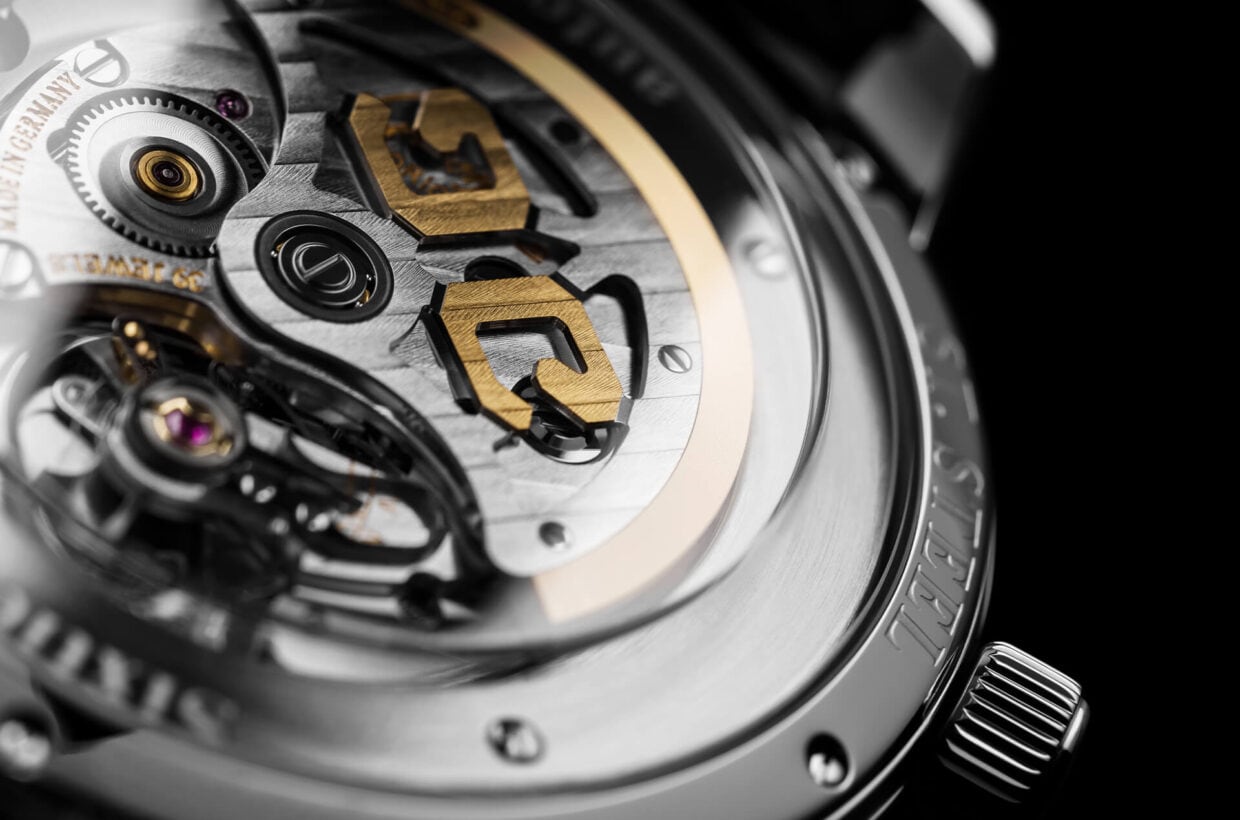

A few watchmakers have truly pushed the big date to its limits:
A. Lange & Söhne
Their “Outsize Date” uses a unique framed tens mechanism—arguably the most precise big date in the industry.
Glashütte Original
Uses two concentric discs to create a seamless “Panorama Date,” with no divider bar between digits.
Blancpain, Breguet, JLC
Each implements its own take on the complication, typically using highly refined modules and silent switching systems.

The Beautiful Paradox of the Big Date
The big date is a prime example of a watchmaking paradox:
The cleaner something looks, the more complex it often is.
Behind the effortless elegance of a big date display lies a compact ecosystem of synchronizing components, torque management, safety systems, and design compromises. It is an engineering triumph hidden in plain sight.
And that’s why collectors love it - and watchmakers respect it.
Ready to start building your collection? Browse our mechanical watches now!
Learn more about MN Watches and our design philosophy here.
To see our most recent watch builds, click here.