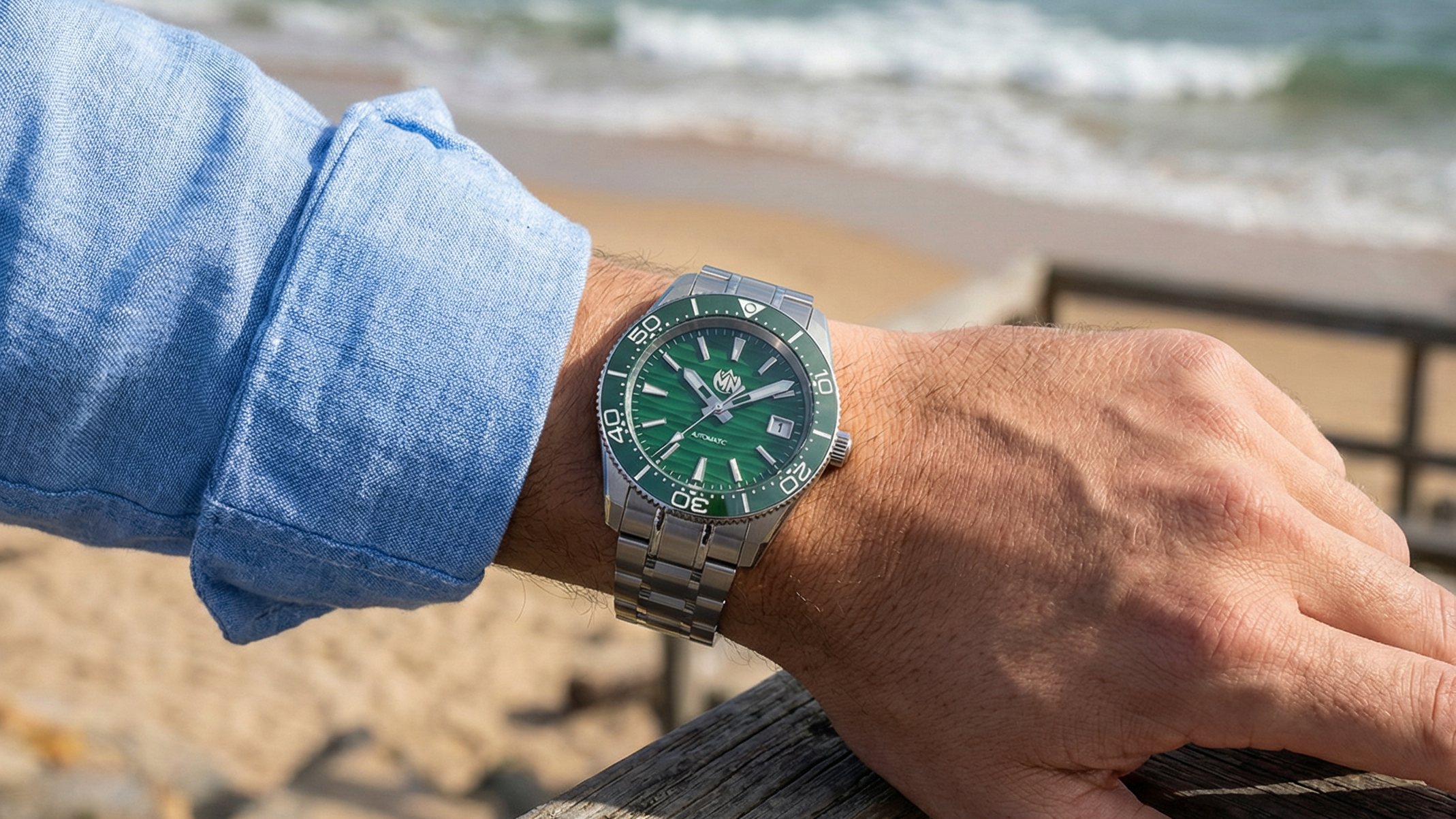
If you're shopping for a watch in 2026, one of the first decisions you'll face is whether to choose a mechanical (often also called an "automatic") or a quartz movement. It's a question that has divided watch enthusiasts for decades and remains one of the most common topics discussed in the watch community.
The truth is that neither technology is objectively better. Each offers distinct advantages, and the right choice depends on what you value most in a watch.
Whether you're buying your first serious timepiece or adding another piece to your collection, understanding the differences between automatic and quartz watches will help you make a more informed decision.
Understanding the Basics
At their core, both automatic and quartz watches serve the same purpose: displaying the time. The difference lies entirely in how they generate and regulate power.
An automatic mechanical watch is a device powered by a mainspring. As you move your wrist throughout the day, a weighted rotor inside the watch spins, winding the mainspring and storing energy. This stored energy is gradually released through a complex series of gears and components that drive the hands around the dial. A "standard" mechanical watch has no automatic function, and must be hand-wound using the crown & stem.
A quartz watch, on the other hand, uses a battery as its power source. Electricity from the battery passes through a quartz crystal, causing it to vibrate at a highly precise frequency. These vibrations are counted electronically and converted into the movement of the watch hands.
One approach represents centuries of traditional craftsmanship. The other represents modern technological efficiency.
A Brief History of the Quartz Revolution

A typical quartz movement - the Seiko 7T62 20
Image source: perrinwatchparts.com
To understand why this debate still exists today, it's helpful to understand a little watchmaking history.
For hundreds of years, every watch was mechanical. The precision of a watchmaker was measured by how accurately they could regulate a mechanical movement.
Everything changed in 1969 when Seiko introduced the Astron, the world's first commercially available quartz wristwatch.
The impact was enormous.
Quartz watches were dramatically more accurate, cheaper to manufacture, and required less maintenance. Throughout the 1970s and 1980s, many traditional Swiss manufacturers struggled to compete. This period became known as the "Quartz Crisis" and fundamentally reshaped the global watch industry.
Ironically, the survival of Swiss watchmaking eventually depended on repositioning mechanical watches not as superior tools, but as luxury products that celebrated heritage, craftsmanship, and engineering.
Today, both technologies coexist successfully because they appeal to different priorities.
Accuracy: The Undisputed Advantage of Quartz
If pure accuracy is your primary concern, quartz watches win decisively.
A high-accuracy quartz watch may gain or lose only a few seconds per year, if at all.
By comparison, a well-regulated mechanical watch may gain or lose between 5 and 15 seconds per day. Some premium Swiss chronometer-certified movements perform even better, although they still cannot match the consistency of quartz technology. For example, Swiss "COSC" (Contrôle Officiel Suisse des Chronomètres) certification requires mechanical watch movements to maintain an average daily accuracy of -4/+6 seconds over a rigorous 15-day testing period.
For most people, however, the practical difference is less significant than it appears.
Many mechanical watch owners enjoy resetting their watches periodically. In fact, interacting with the watch is often considered part of the ownership experience.
The Emotional Appeal of Mechanical Watches

The beauty of a mechanical movement
Image source: mn-watches.com
This is where the conversation becomes more interesting.
Ask a mechanical watch owner why they chose a mechanical movement, and accuracy is rarely the first answer.
Instead, they'll talk about craftsmanship.
A mechanical movement may contain over one hundred individual components working together in perfect harmony. Tiny gears, springs, jewels, and levers perform an intricate mechanical dance every second of every day.
The movement itself becomes a piece of miniature engineering art.
Many enthusiasts enjoy watching the smooth sweeping second hand, listening to the subtle ticking of the escapement, or viewing the movement through an exhibition caseback.
A mechanical watch offers a connection to centuries of watchmaking tradition that simply cannot be replicated by a battery-powered device.
Maintenance and Ownership Costs
One area where quartz watches maintain a clear advantage is maintenance.
A quartz watch requires very little attention. In most cases, replacing the battery every few years is sufficient to keep it running accurately.
Mechanical watches require more care.
Lubricants inside the movement gradually degrade over time. To maintain performance and reliability, most manufacturers recommend servicing a mechanical watch every three to seven years, depending on the movement and usage.
While this represents an additional cost, many collectors view servicing as similar to maintaining a classic car. It's simply part of preserving a precision mechanical instrument.
The upside is longevity.
A quality mechanical watch can remain functional for generations if properly maintained. Many vintage mechanical watches from the 1950s and 1960s continue to operate today.
Durability in Everyday Life
Many people assume quartz watches are always more durable, but the reality is more nuanced.
Quartz watches generally handle impacts and vibration very well due to their relatively simple construction.
Modern mechanical watches, however, are far more robust than many people realize. Features such as shock protection systems and improved manufacturing tolerances make today's mechanical movements remarkably resilient.
For everyday office work, travel, and recreational activities, either technology is perfectly suitable.
Value and Price Considerations
At lower price points, quartz watches often deliver exceptional value.
A $100 quartz watch can offer excellent reliability, attractive design, and years of trouble-free performance.
As budgets increase, the equation changes.
Buyers often begin looking beyond simple functionality and start valuing craftsmanship, finishing quality, movement architecture, and heritage.
This is where mechanical watches become particularly appealing.
For many enthusiasts, the movement itself becomes one of the most important features of the watch.
Which Watch Is Right for You?
Choose a quartz watch if:
-
You prioritise accuracy above all else
-
You prefer minimal maintenance
-
You want a reliable grab-and-go timepiece
-
Budget is a major consideration
Choose a mechanical watch if:
-
You appreciate traditional craftsmanship
-
You enjoy mechanical engineering
-
You want a watch with emotional and historical significance
-
You value the ownership experience as much as the functionality
The Verdict for 2026
The mechanical versus quartz debate will likely continue for decades, but the answer has become increasingly personal.
Quartz watches are unquestionably superior tools for keeping accurate time.
Mechanical watches are often superior objects of passion.
At MN Watches, we believe a watch should be more than a timing instrument. It should tell a story, reflect personal taste, and provide enjoyment every time you glance at your wrist.
That is why we continue to champion high-quality mechanical movements that combine proven reliability with the timeless appeal of traditional watchmaking.
If you're choosing your first serious watch, don't simply ask which movement is better.
Ask which one you'll still enjoy wearing ten years from now.
That answer is usually the right one.
Ready to start building your collection? Browse our mechanical watches now!
Learn more about MN Watches and our design philosophy here.
To see our most recent watch builds, click here.