Few objects in horology embody the marriage of necessity, engineering, and romance quite like the dive watch. Born from humanity’s desire to explore the underwater world, the mechanical dive watch evolved from a fragile experiment in water resistance into one of the most enduring and iconic categories in watchmaking. Today, it is both a professional instrument and a cultural symbol - worn as readily in the boardroom as beneath the sea.
For enthusiasts of mechanical timekeeping, understanding the evolution of the dive watch is to trace a story of innovation under pressure - literal and technological - spanning nearly a century.
The Origins of Underwater Timekeeping
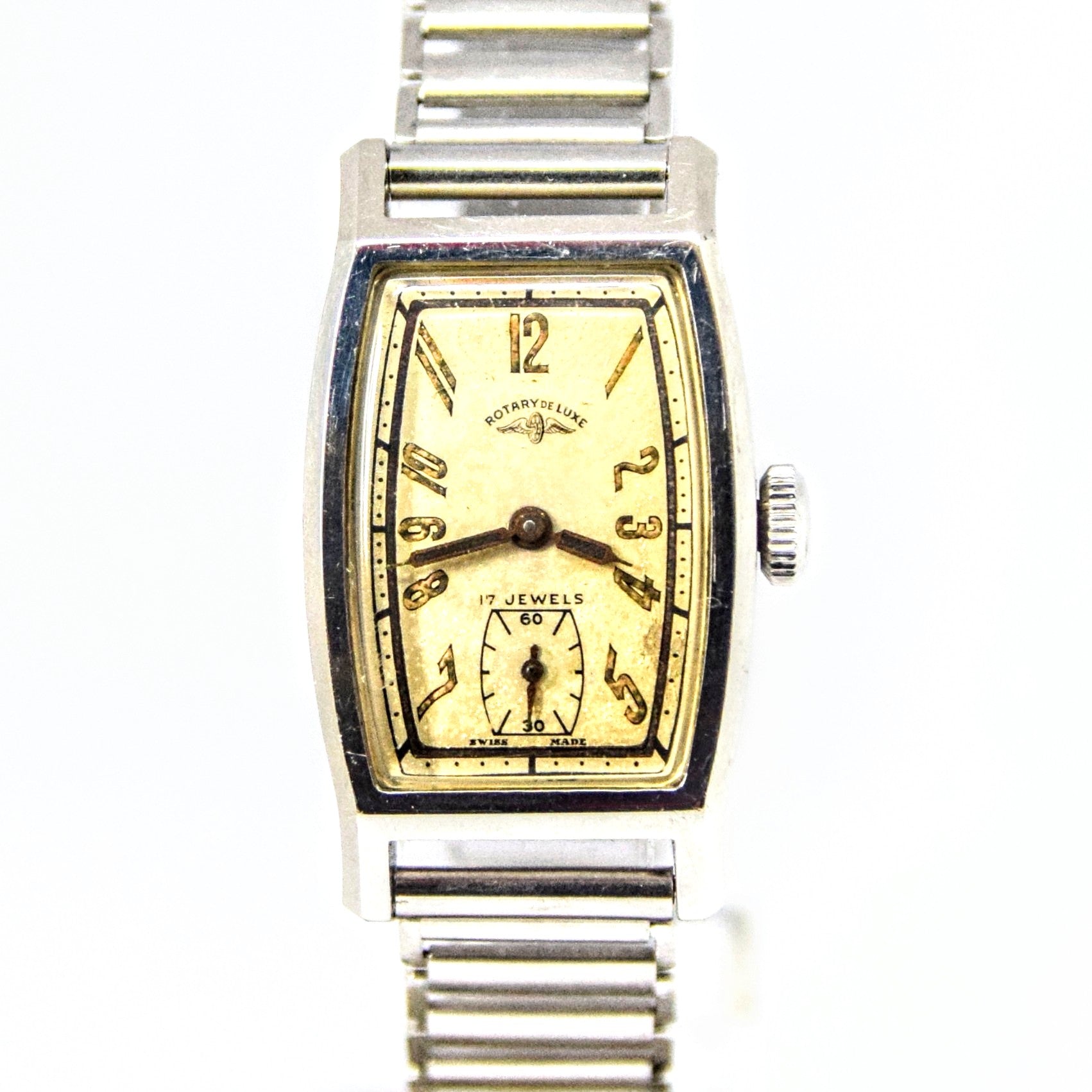
A rare 1930s Rotary Deluxe Deco Tonneau Wristwatch with early waterproof patent. Image source: Antique Watch
The foundations of the dive watch predate recreational scuba diving itself. In 1926, Rolex introduced the Oyster case, the world’s first commercially successful waterproof wristwatch case. With its screw-down crown, caseback, and bezel, it created a sealed environment capable of resisting water ingress - a breakthrough at a time when most watches feared even rain.
The following year, Mercedes Gleitze swam the English Channel wearing a Rolex Oyster, demonstrating its water resistance in a public relations triumph that laid the groundwork for the tool watch concept. Although not yet a “dive watch” in the modern sense, the Oyster established the engineering principles that would define underwater horology for generations.
The Birth of the Modern Dive Watch (1950s)

Image source: https://teddybaldassarre.com/
The true dive watch emerged in the early 1950s, catalyzed by the rise of recreational scuba diving and military underwater units. Self-contained underwater breathing apparatus (SCUBA), pioneered by Jacques Cousteau and Émile Gagnan, allowed divers to remain submerged for extended periods - creating a critical need for reliable timing devices to track oxygen supply and decompression intervals.
In 1953, Blancpain unveiled the Fifty Fathoms, widely considered the first purpose-built modern dive watch. Designed in collaboration with French naval combat divers, it introduced several now-standard features: a rotating bezel for elapsed time measurement, high-contrast luminous markers for legibility, and robust water resistance.
Shortly thereafter, Rolex introduced the Submariner (1954), refining the concept with enhanced durability and improved depth ratings. The Submariner would become the archetype of the dive watch - technically capable and aesthetically timeless.
In 1957, Omega launched the Seamaster 300, further solidifying the category’s legitimacy among professional and military divers. By the end of the decade, the essential architecture of the mechanical dive watch had been established: screw-down crown, unidirectional rotating bezel, luminous dial, and high water resistance.
The Era of Professionalisation and Depth Records (1960s–1970s)

Image source: doxawatches.com
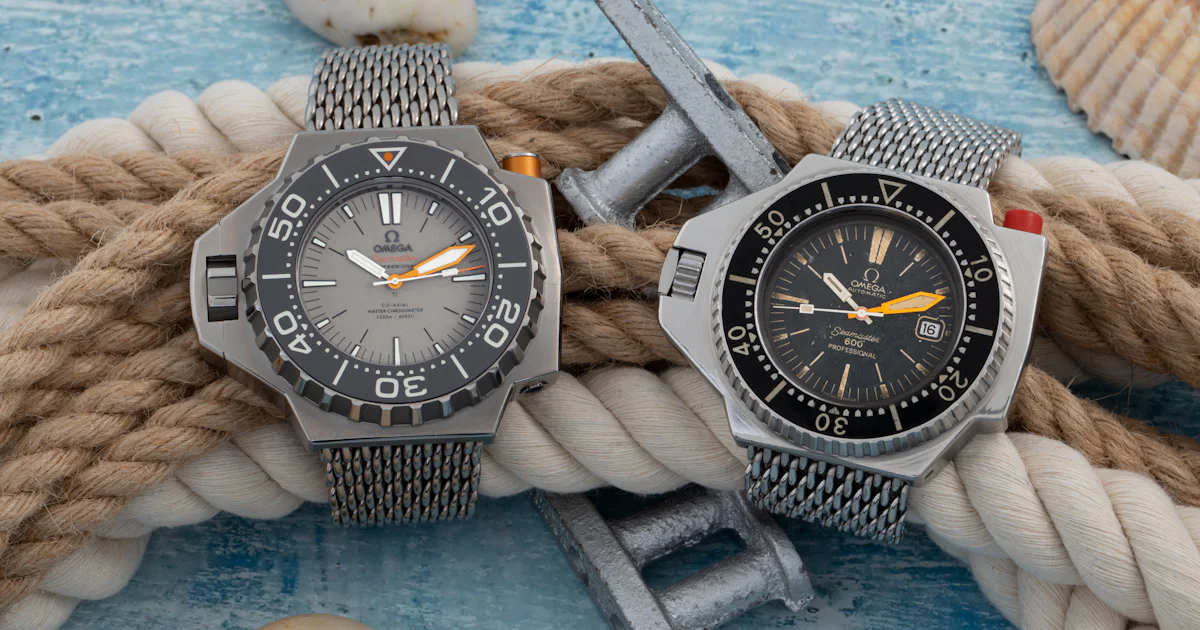
Image source: hodinkee.com
As commercial and saturation diving expanded in the 1960s, dive watches faced new technical challenges. Helium molecules used in saturation diving could infiltrate watch cases during prolonged deep-sea missions, causing crystals to pop off during decompression.
To address this, Rolex introduced the Sea-Dweller in 1967, featuring the pioneering helium escape valve. This innovation allowed trapped gas to exit safely during decompression - a milestone in dive watch engineering.
Meanwhile, Doxa collaborated with Jacques Cousteau’s team to develop the Sub 300, notable for its high-visibility orange dial and no-decompression scale bezel - a design tailored explicitly to underwater readability.
In 1970, Omega released the Ploprof 600 (Plongeur Professionnel), a radical monobloc case design capable of extreme depths, while Seiko introduced its 6159 Professional 300m diver, showcasing Japan’s rising dominance in high-performance dive watches.
During this period, water resistance ratings surged from 100–200 meters to 600 meters and beyond. Case construction evolved, gaskets improved, and crystal materials strengthened. The dive watch had become a serious professional instrument.
The Quartz Crisis and Reinvention (1970s–1990s)
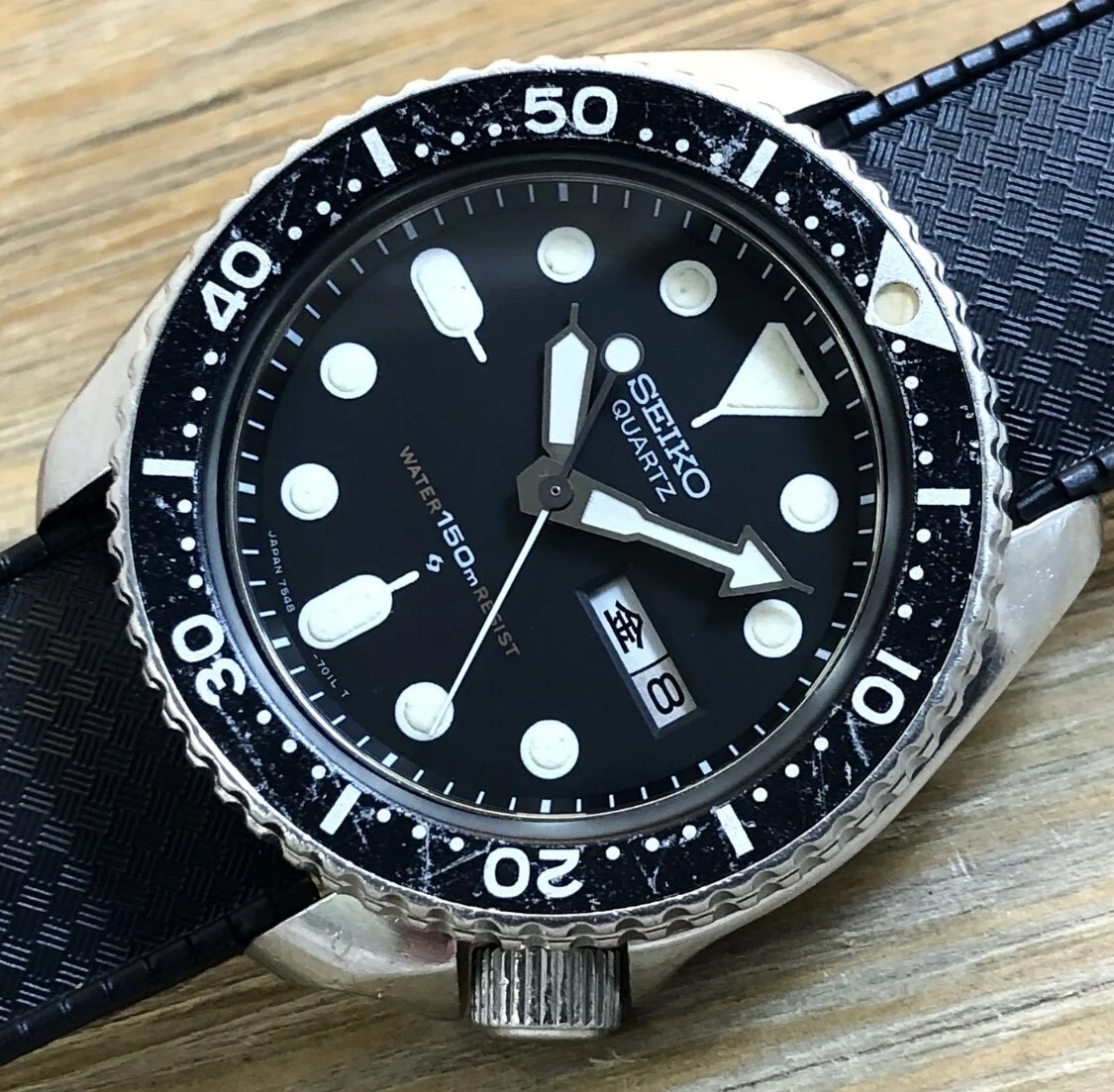
Image source: https://www.hubcityvintage.com/
The arrival of quartz technology in the 1970s disrupted the mechanical watch industry. Quartz dive watches offered superior accuracy and often improved reliability at lower cost. Brands such as Seiko led this transition, producing robust quartz divers that gained global popularity.
Yet mechanical dive watches survived - not merely as tools, but as symbols of craftsmanship and resilience. The category’s rebirth was aided by standardisation. In 1996, ISO 6425 formalised requirements for dive watches, including water resistance of at least 100 meters, unidirectional bezels, legibility standards, and magnetic resistance testing. Certification reinforced the professional credibility of the mechanical dive watch.
The 1993 launch of the Omega Seamaster Professional 300M helped reintroduce the dive watch to a new generation, blending technical competence with refined aesthetics and mainstream appeal.
The Modern Era: Engineering Extremes and Cultural Icon

Image source: jaztime.com
Today’s dive watches reflect both extraordinary engineering capability and lifestyle versatility. In 2008, Rolex introduced the Deepsea, rated to 3,900 meters, incorporating its Ringlock system to manage immense pressure forces. Omega later unveiled the Ultra Deep, tested in real-world dives to the bottom of the Mariana Trench.
Meanwhile, brands such as Tudor have embraced advanced materials like titanium and ceramic, improving corrosion resistance and wearability. Modern luminous compounds (Super-LumiNova), ceramic bezels, sapphire crystals, and advanced anti-magnetic movements represent decades of incremental refinement.
Ironically, while professional divers increasingly rely on digital dive computers, the mechanical dive watch endures - valued for its reliability, independence from batteries, and emotional resonance. It remains a mechanical instrument capable of surviving in one of Earth’s most hostile environments.
The Dive Watch as Enduring Archetype
From the early waterproof cases of the 1920s to the saturation-ready marvels of today, the evolution of the dive watch mirrors broader trends in watchmaking: innovation under constraint, adaptation to technological disruption, and eventual transformation into a cultural icon.
What began as a life-preserving tool for underwater pioneers became one of the most recognisable watch designs ever created. Its clear dial, rotating bezel, and robust case speak a language understood by enthusiasts worldwide.
For modern collectors - whether exploring alpine lakes in Switzerland or simply appreciating mechanical craft - the dive watch represents the perfect intersection of engineering integrity and aesthetic restraint. It is a reminder that true innovation often begins with a practical problem, solved elegantly.
And beneath the surface of every great dive watch lies nearly a century of human curiosity, technical mastery, and relentless pursuit of depth.
Ready to start building your collection? Browse our mechanical watches now!
Learn more about MN Watches and our design philosophy here.
To see our most recent watch builds, click here.